36 Governor Races: 19 Open Seats and the Path to a Democratic Majority
Democrats need a net gain of two governorships to reclaim control, facing a split field and heavy Republican spending in key battlegrounds.
By Tyler Khalil ·
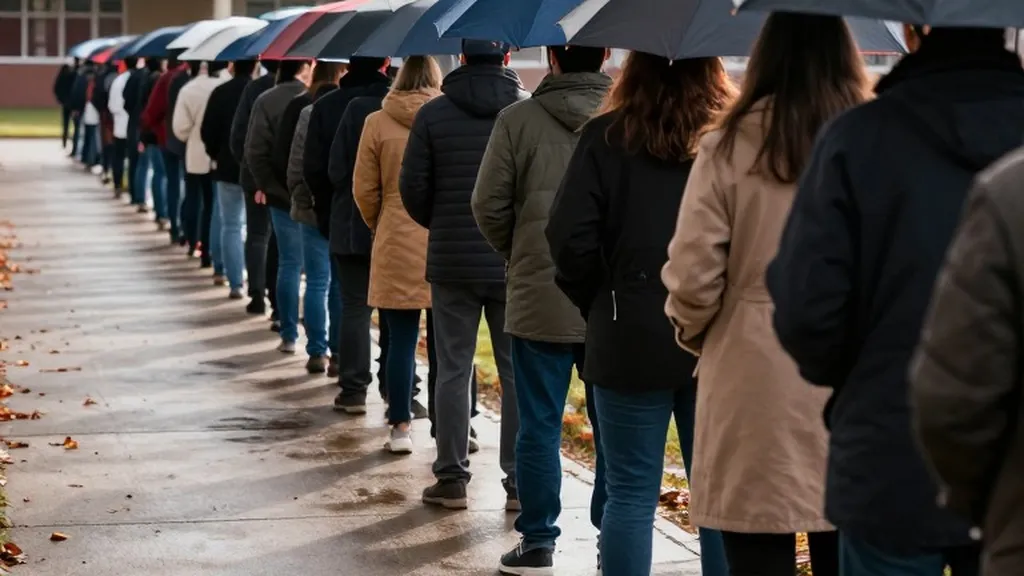
Voters across the nation are casting ballots on Tuesday to decide the control of thirty-six governorships in a midterm election that serves as a referendum on the second term of President Donald Trump. The race for statehouses is distinct from the congressional contests because the distribution of seats is evenly divided on the ballot. Republicans hold eighteen of the thirty-six governorships up for election, while Democrats hold the other eighteen. This precise 18 to 18 split creates a high-stakes scenario where a net gain of just two seats would allow Democrats to claim a nationwide majority for the first time since 2010.
The composition of the field is heavily influenced by the high number of open seats. Nineteen of the thirty-six governor races have no incumbent on the ballot, a figure driven by term limits and voluntary departures. Ballotpedia notes that fifteen governors are term-limited and cannot seek re-election. Additionally, Iowa Governor Kim Reynolds, Minnesota Governor Tim Walz, and Wisconsin Governor Tony Evers chose not to run for another term. Rhode Island Governor Daniel McKee lost his primary, leaving his seat open as well. This large number of open seats introduces uncertainty, as voters must evaluate challengers without the baseline of an incumbent’s record.
The competitive landscape is concentrated in nine battleground states identified by Ballotpedia: Alaska, Arizona, Georgia, Iowa, Kansas, Michigan, Nevada, Ohio, and Wisconsin. In these states, the outcome of the governor’s race is closely tied to the broader political mood. Democrats are defending five governorships in states that Donald Trump won in 2024, including Arizona, Kansas, Michigan, Pennsylvania, and Wisconsin. Conversely, Republicans are defending two seats in states that Kamala Harris won in 2024, specifically New Hampshire and Vermont. This cross-over of party control and presidential voting patterns makes these nine states critical to the final count.
Several high-profile matchups have drawn national attention from the Associated Press and PBS NewsHour. In Georgia, Republican health care executive Rick Jackson is running against Democratic former Atlanta Mayor Keisha Lance Bottoms to succeed Brian Kemp. In Nevada, Republican Governor Joe Lombardo faces Democratic Attorney General Aaron Ford. In Ohio, the race features Republican Vivek Ramaswamy against Democrat Amy Acton. The Associated Press notes that Ramaswamy’s campaign faced significant backlash over an advertisement featuring Acton’s estranged mother, a development that has shaped the local narrative. These named contests provide clear focal points for voters who may otherwise view the governor’s race as a secondary choice.
Financial dynamics play a significant role in these contests, with the 2026 elections likely to be the most expensive in history. Republican committees have outraised and outspent Democratic committees, aided by Trump-affiliated groups and the support of Elon Musk. However, the Associated Press analysis of AdImpact data reveals a strategic focus on Republican spending. Eighty-eight.1 percent of Republican general election television ad spending went to states and districts that Trump won in 2024. This includes more than $850 million in spending in areas where he won by ten points or more. Despite this committee-level advantage, Democrats outraised their opponents at the candidate level, suggesting a different strategy in direct voter outreach.
The issues driving voter interest in governor races align with the national mood. Voters are struggling with high prices and are angry over an unpopular war with Iran. Only 35 percent of U.S. Adults approve of Trump’s job performance, and about 70 percent believe the country is heading in the wrong direction. James Moore, a 57-year-old librarian in Raleigh, North Carolina, said that he is paying more taxes, more for health care, and more for everything. These personal financial concerns are central to the debate in the nineteen open seats, where candidates are pitching their administrative experience and policy plans to a skeptical electorate.
The administration of the election has also been a point of contention, with legal challenges affecting voter confidence. A federal judge temporarily barred the Trump administration from carrying out a plan to prevent noncitizen voting, a move critics said risked disenfranchising eligible voters. More than 57 million people had already voted as of Monday, surpassing the early vote totals from four years ago in many closely watched states. This high early turnout suggests that voters are engaged and that the final tally will depend heavily on the in-person voting patterns on Election Day itself.
The stakes extend beyond the immediate control of state governments. A strong Democratic performance in the governor races would boost potential 2028 candidates such as Gavin Newsom, JB Pritzker, and Pete Buttigieg. It would also complicate the path for Vice President JD Vance. Republicans have attempted to beat the traditional midterm pattern, where a president’s party often loses seats, by leveraging redistricting. However, new districts in Florida and other states may not vote as expected, adding another layer of complexity to the final results. The outcome of these thirty-six races will define the balance of power in statehouses for the next four years.
As polls close across the country, the focus turns to the aggregation of results in the nineteen open seats and the nine battlegrounds. The Associated Press describes the election as a moment where one or two seats could tip the balance of power. Democrats are cautiously optimistic, while Republicans are bracing for potential losses in the House and fighting to hold the Senate. The governor races offer a clear measure of the public’s satisfaction with the current administration’s handling of the economy and foreign policy. With the votes now in, the nation awaits the first signs of which party will claim the majority of statehouses.