Rubio cancels G20 photo as European diplomats object to Lavrov
The cancellation in Atlanta signals deep divisions among major economies just days before the U.S. midterm elections.
By Tyler Khalil ·
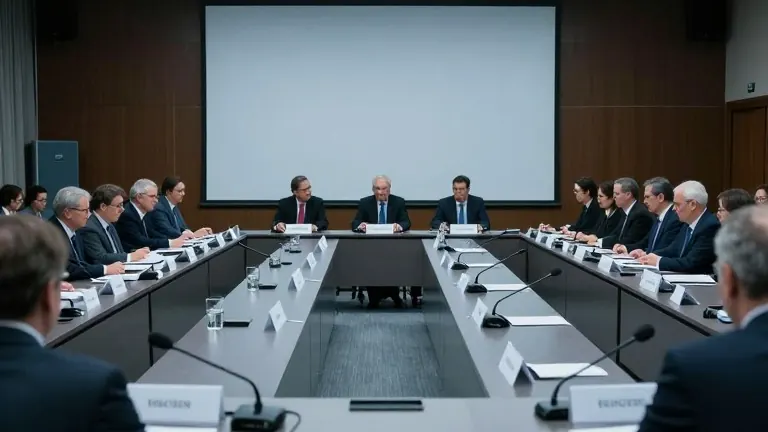
U.S. Secretary of State Marco Rubio canceled the traditional group photograph for G20 diplomats on Friday in Atlanta.
The decision followed objections from several European nations that did not want their foreign ministers pictured alongside Russian Foreign Minister Sergey Lavrov.
Two anonymous U.S. officials said Rubio made the call to avoid a distraction during the opening day of talks.
The meeting is scheduled to proceed as planned, with the goal of preparing for a leaders' summit hosted by President Donald Trump at his Miami golf club in December.
The cancellation highlights the friction within the group of 20 largest world economies regarding global security and trade issues.
Key points of contention include the Russia-Ukraine conflict, the U.S.-Israeli war against Iran, U.S. tariffs, and Chinese activities in the South China Sea.
Rubio told the gathering that the world faces a series of interconnected economic and geopolitical crises that pose severe threats to the global economic order.
He described the current moment as a choice not just for the United States, but for the entire world.
European diplomats expressed discomfort with Russia's presence, noting that Moscow was invited despite its heightened attacks on Ukraine.
Polish Deputy Prime Minister and Foreign Minister Radosław Sikorski called the cancellation the right decision and stated that he was not the only one who did not want to be photographed with Lavrov.
German Foreign Minister Johann Wadephul said there is no normality with Russia, but the controversies must be exchanged at the table.
He added that the group must not send falsely optimistic signals to the world, according to the German news agency dpa. Russia's foreign ministry claimed that visa issues for its delegation were resolved at the last minute, creating an impression that not everyone in Washington was happy about Lavrov's attendance. Ministry spokeswoman Maria Zakharova said Lavrov would use the meeting to advocate for the swift reform of global economic institutions. Lavrov has rarely traveled to NATO member states since Russia's invasion of Ukraine in February 2022, and his presence in Atlanta is expected to cause domestic political problems for Trump just before the midterm elections. Ian Kelly, a former U.S. ambassador to Georgia, called the invitation politically boneheaded, noting that many Republican lawmakers are already critical of Trump's conciliatory approach to Putin. Kelly argued that Lavrov's attendance would hurt efforts to produce a unified Western approach on the Russia-Ukraine war. South Africa, a G20 founding member and the only African country in the group, was not invited to the Atlanta meeting. Phindile Kunene, spokesperson for South African Foreign Minister Ronald Lamola, said South Africa's nonparticipation was not voluntary and that the country was ready to participate on an equal footing when Britain takes over the presidency next year. Ukraine, which was invited to previous meetings, was also excluded this year because U.S. officials chose to include only formal members. The U.S. has identified resolving differences over freedom of navigation in the Strait of Hormuz, the Red Sea, the Black Sea, and the South China Sea as a top priority for the talks. These discussions will include topics related to Iran, Russia-Ukraine, and China. The prospect of new U.S. military intervention in Iran hangs over the meeting, with U.S. officials telling regional allies to prepare for potential renewed strikes after Tuesday's midterm elections. Elaine Dezenski, head of the Center on Economic and Financial Power at the Foundation for Defense of Democracies, described the Atlanta meeting as a test of whether the U.S. can build cooperation with partners when consensus appears out of reach.