Moscow Airports Face Nine Hour Closures Daily as Drone Alerts Persist
Rosaviatsiya's carpet protocol triggers daily suspensions at four major hubs, with analysts warning of rising risks for civilian aircraft.
By Jason Kovalenko ·
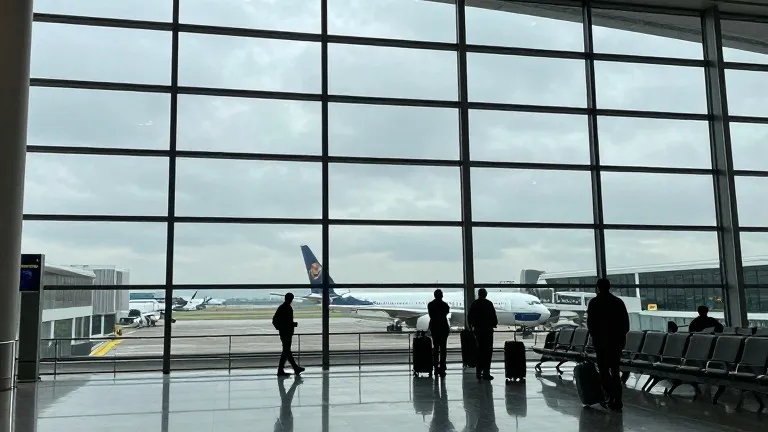
Moscow's four major airports have suspended operations for up to nine hours on a daily basis this month, according to data from the independent investigative outlet Agentstvo. The closures at Domodedovo, Sheremetyevo, Zhukovsky, and Vnukovo represent a sharp increase in disruption compared to previous months of the ongoing conflict.
The operational halt stems directly from a safety procedure implemented by Russia's aviation authority, Rosaviatsiya. Known as the carpet protocol, the rule mandates an immediate closure of airspace over a region if an aircraft violates borders, weapons are used, or unidentified objects appear. Once triggered, strict limits are applied to all air traffic in the affected zone.
Oleksandr Laneckij, chief executive of the consultancy Friendly Avia Support, stated that every drone currently poses a military threat to the region. He drew a parallel to the Houthis in Yemen, who disrupted Saudi airspace, but noted that Ukraine's military capabilities far exceed those of the Yemeni group. This assessment aligns with the stated goal of Ukrainian President Volodymyr Zelenskyy, who declared in early September that Russian airspace would become completely unsafe.
Military analyst Jan Matvejev observed that Ukraine requires only simple drones without warheads or long range to trigger the protocol. He noted that Ukraine's industrial capacity allows for the production of hundreds of combat ready long range drones daily. This output makes it difficult for Russian air defenses to maintain full effectiveness against the persistent aerial activity.
Experts warn that the current protocol creates specific dangers for civilian flights. Laneckij pointed to the December 2024 crash of an Azerbaijan Airlines flight, in which 38 people died after a Russian air defense missile, fired to counter drones, struck the aircraft. Matvejev argued that Russian air defenses have not changed significantly since that incident, leaving a risk that mass produced missiles could veer toward nearby airliners.
The disruption has already impacted other locations, including Pskov airport in summer 2023 and Sochi airport earlier this month. As foreign airlines evaluate their exposure, Laneckij identified military threat, demand, and insurance costs as the three key factors. Insurers may sharply raise premiums if they rate the risk as very high, which would drive ticket prices up for the remaining foreign carriers operating in the Russian market.