McCollum captures Halley debris trails in Georgia
Three Orionid meteors from Comet 1P/Halley were recorded over Toccoa on Oct. 21, weeks before the shower reaches peak intensity.
By Thiago Kovalenko ·
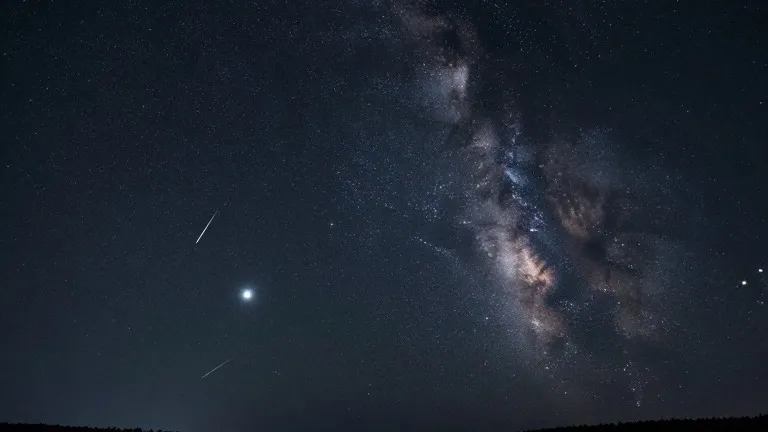
Astrophotographer Tim McCollum captured three distinct Orionid meteors above Toccoa, Georgia, on Oct. 21. The image documents debris from Comet 1P/Halley striking the atmosphere while the parent comet remains more than 3 billion miles away. This activity occurred before the annual shower reached its peak activity period.
The meteors appeared between 3 a.m. and 4 a.m. local time. Each trail radiated outward from a specific point in the sky known as the radiant. This origin point is located near Betelgeuse, a red giant star in the constellation Orion. The visual alignment confirms the meteorological source of the glowing particles.
McCollum used a Canon EOS Ra camera paired with an RF 28-70 f2.0 lens to record the event. He employed a star tracker to keep the camera fixed on the radiant during multiple 30-second exposures. The individual frames were later combined using PixInsight software to create a single composite image. This technical approach allows for the capture of faint, fast-moving objects that might be missed in a single shot.
The final frame contains several other celestial features beyond the meteor trails. The stars of Orion's Belt appear on the right side of the image, adjacent to the Orion Nebula. This nebula is one of the nearest major star-forming regions to Earth. The Rosette Nebula, designated as Caldwell 49, is also visible within the dense starfield and dust lanes of the Milky Way's galactic plane.
The Orionid meteor shower remains active until Nov. 7. This timeline provides additional opportunities for observers to view meteors from Halley's Comet. The current activity level is building toward the expected peak in late October. Early detection of these trails offers a preview of the shower's intensity.
Earth is currently passing through debris streams associated with Comet 2P/Encke. This overlap produces the Taurid meteor shower. Observers may occasionally see bright fireballs from this secondary stream during the same period. The combination of Orionid and Taurid activity creates a complex meteor environment for late October skywatchers.