Lander resident plans third winter of cold river plunges
Felicity Hnilicka aims to complete her first full season in the Popo Agie, a practice she credits for improved sleep and discipline.
By Thiago Kovalenko ·
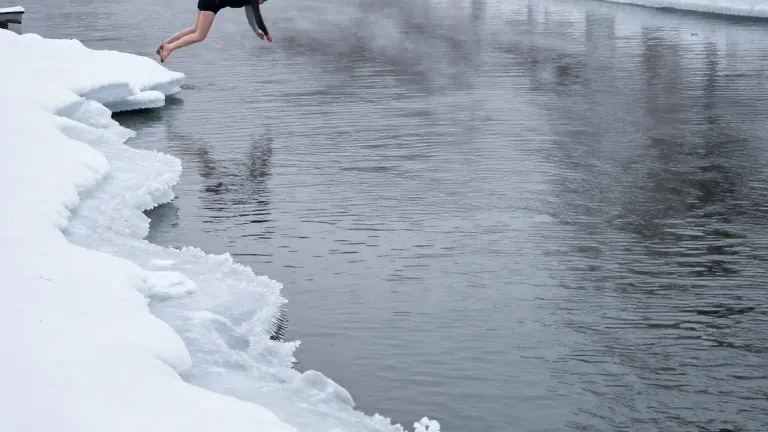
Felicity Hnilicka has attempted to swim in the icy Popo Agie River for three consecutive winters, yet she has never completed a full season. The 24-year-old Lander resident now intends to change that record, recruiting other local residents to join her at the City Park bridge near McManus. Her goal is to maintain a consistent schedule of cold-water immersions from November through the spring.
Hnilicka describes the activity as a tool for mental toughness rather than a sport. She cites improvements in sleep, circulation, and stress management as primary benefits. She views the act of overcoming the initial reluctance to enter the water as a transferable skill for daily tasks. "If I can just say, 'You gotta go, you gotta do it,' then it's also helped translate into not procrastinating my life events," she said.
The physical routine involves brief initial exposures that expand to five or ten minutes as the season progresses. Hnilicka typically enters the water in November when temperatures are dropping but the season has not yet peaked. She prepares for the cold by running her car heater and keeping a warm towel and hot tea nearby. The Popo Agie offers varying depths, allowing for both wading and full immersion.
Ward Dobbs, an assistant professor of kinesiology and health at the University of Wyoming, explained the physiological mechanisms behind the practice. He noted that the body reacts to icy water with a powerful stress response, causing heart rate to accelerate and breathing to become rapid. Simultaneously, submerging the face in cold water triggers a reflex that slows the heart. This creates a state of cardiovascular conflict. For healthy individuals, the body can tolerate this stress, though those with underlying conditions face higher risks.
Dobbs pointed out that flowing water presents greater challenges than stationary cold plunges. Moving water carries away heat continuously, preventing the thin layer of skin temperature from warming up. This increases convective heat loss. He warned that prolonged exposure can interfere with muscle function and coordination. Even trained swimmers may struggle to climb out of the water because their muscles stop responding effectively, a risk distinct from hypothermia.
Repeated exposure allows the body to adapt, a process Dobbs compared to acclimating to heat stress. He cautioned that while some people report mental clarity and mood improvements, these effects are not universal. The practice mirrors cultural traditions in Finland, where individuals alternate between saunas and cold lake plunges to constrict and dilate blood vessels. This cycle is believed to improve blood flow, though Dobbs emphasized that balance is required to avoid excessive strain.
The trend has gained traction among other Wyoming residents. Kimberly Coats, who lives on a 600-acre ranch in Savery, tried the practice with her husband after he began taking cold showers. They chopped a hole in the ice of Savery Creek and entered water that was 32 degrees when the air temperature was around 20 degrees. Coats described the experience as producing a tingling sensation and a feeling of being incredibly awake. She compared the aftermath to a "manufactured high," a reaction that led her to understand the appeal of the activity.
Coats and her husband always entered the creek together to ensure safety. They stopped the practice in the following spring after a medical diagnosis unrelated to the cold water advised them to discontinue. Despite the pause, Coats maintains that the immersion in a natural river environment offers a different experience than a backyard tub. She finds the cold invigorating and continues to enjoy outdoor activities in low temperatures, noting that the specific setting of the river is central to the appeal.
More Business · Rip-Off Report · Report a business · Got a Story?