Hebron Crisis: Eviction Orders Issued for 250,000 Residents After Checkpoint Attack
Prime Minister Netanyahu declared a siege and ordered mass demolitions following the death of two soldiers, drawing legal challenges and criticism from rights advocates.
By Thiago Kovalenko ·
Israel has initiated a military and administrative campaign in Hebron following a fatal shootout at a checkpoint.
Prime Minister Benjamin Netanyahu announced a siege of Hebron and the neighboring town of Halhul on Friday. He stated that residents of the specific neighborhoods where the gunmen resided would be forced to leave. The government also pledged widespread demolition of homes in those areas.
The orders affect approximately 250,000 people, who comprise the population of Hebron, the largest Palestinian city in the occupied West Bank. Netanyahu indicated that preparations were underway for the largest military operation in the West Bank since 1967, though he said no specific date had been set for the launch.
The incident began when two men armed with an assault rifle and a handgun drove a vehicle with Israeli license plates to a temporary checkpoint outside the city. Soldiers stopped the car, and the men opened fire. A gunfight lasting 20 minutes followed, resulting in the deaths of two Israeli soldiers and injuries to three others. The two gunmen were killed during the exchange.
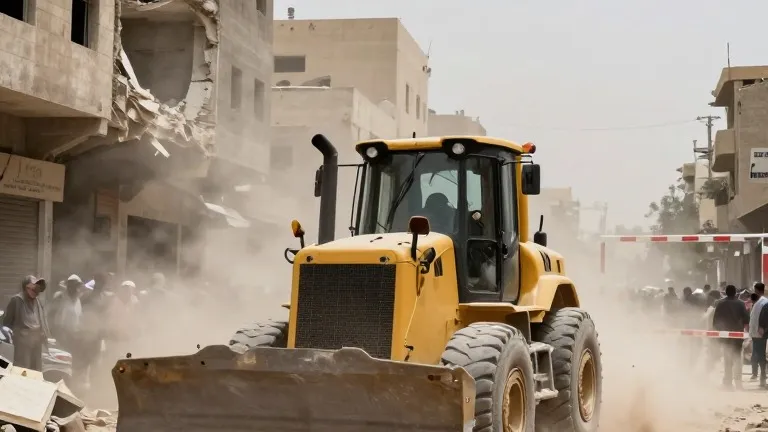
Within hours of the attack, Finance Minister Bezalel Smotrich filmed himself standing before a bulldozer as it demolished a Palestinian home near the site. Smotrich described the structure as unpermitted and said the destruction was intended to create deterrence and extract a price. He did not claim a direct link between the home's owners and the attackers.
Defense Minister Israel Katz reinforced the government's stance by promising further displacement. He compared the planned actions in Hebron to the treatment of the Jenin refugee camp, where nearly 20,000 residents have been forced from their homes. Katz declared that every clan neighborhood from which the terrorists emerged would be evacuated.
Legal challenges emerged quickly after the demolition began. The Israeli high court issued a temporary order halting the destruction of buildings. The ruling followed an urgent petition filed by human rights lawyer Mohammed Dahleh on behalf of two factory owners nearby. Dahleh argued that the demolitions violated international laws regarding collective punishment and Israeli administrative statutes.
Michael Sfard, a prominent Israeli lawyer, characterized Smotrich's video as a direct admission that the actions constituted collective punishment. He noted that deterrence has historically been used as a justification for such measures. The legal dispute highlights the tension between military responses to security threats and established administrative norms in the West Bank.
The event occurred during a period of heightened tension. More than 1,100 Palestinians have been killed by Israeli forces or settlers since October 2023. Violence has intensified since the olive harvest began in late September. National Security Minister Itamar Ben-Gvir visited Hebron on Friday, demanding the dismantling of the Palestinian Authority and stricter restrictions on Palestinian movement.
The political timing is notable as the governing far-right coalition faces elections on Tuesday. Polls suggest the coalition may lose its majority. The rapid response by ministers, including Smotrich and Ben-Gvir, aligns with campaign rhetoric advocating for stronger measures against Palestinians in the West Bank.