Solar Tags Track Monarch Migration
Researchers have equipped 1,750 butterflies with lightweight devices to map their 3,000-mile journey to Mexico.
By Thiago Kovalenko ·
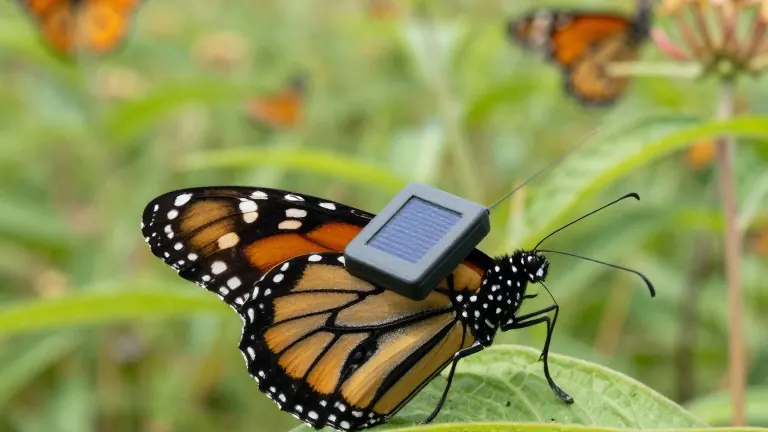
Scientists have attached solar-powered radio tags to nearly 1,750 monarch butterflies to track their migratory routes.
The devices, developed by Cellular Tracking Technologies, weigh approximately the same as a drop of water. Rebeca Quiñonez-Piñón, a senior scientist at the National Wildlife Federation, leads the study. Her team joined a tri-national group to monitor how the insects move through the United States and Mexico. The primary goal is to identify specific stopover locations where butterflies rest and feed. These sites are disappearing due to habitat loss, pesticide use, and climate change.
Monarch butterflies travel up to 3,000 miles from southern Canada to oyamel fir forests in central Mexico. The destination is a protected World Heritage site. While the final destination is known, the intermediate paths have remained unclear. Eastern monarchs typically pass through a narrow corridor in Texas known as the Texas funnel. However, their specific routes vary by year depending on the availability of water, nectar, and shelter. The new tracking data provides real-time information on these movements. Since the project began, researchers have detected the first evidence of a western monarch joining eastern populations in central Mexico. Other tagged insects have been tracked from Florida across the Gulf of Mexico into Mexico, a route observed in higher numbers than previously recorded.
Emma Pelton, a senior conservation biologist with the Xerces Society for Invertebrate Conservation, noted that the data reveals connections between populations that scientists previously hypothesized but could not prove. She stated that the team is thrilled with the progress after one year, particularly because older tracking devices were too heavy for the insects. To ensure the tags do not burden the butterflies, researchers select individuals weighing more than 400 milligrams. The tagging process involves calming the insects in cool temperatures and applying adhesive to their abdomens. The transmitters are then pressed into place. About 175 tagged butterflies have been detected in Mexico since the migration started this year.
Louie Yang, an insect ecologist at the University of California, Davis, described the technology as remarkable. He noted that it allows scientists to observe path selection and movement speed for the first time. However, he cautioned that the technology has limitations. The tags indicate the location of a receiver that detected the signal, not the exact position of the butterfly. Additionally, a detection does not confirm the insect is still alive. Further studies are required to determine if the tags affect natural behavior.
The monarch population has declined sharply. Eastern numbers have dropped more than 80 percent since the mid-1990s, while western numbers have fallen by about 95 percent. Tierra Curry, a senior scientist with the Center for Biological Diversity, cited climate change as a primary threat. Prolonged heat in northern areas can delay migration cues, while late freezes can prevent butterflies from reaching Mexico. Droughts also dry up essential water and nectar sources. In Texas, some highways have installed nets to encourage butterflies to fly higher, reducing collisions with vehicles. Conservationists are also planting milkweed and pollinator plants in gardens and along roadsides to support local populations.
The federal government delayed a decision on protections for monarchs late last year. A court ordered the administration to make a final determination by 2030 after several groups filed a lawsuit. The public can follow individual butterflies using the free Project Monarch Science app.