Rocket Lab Deploys Three Virginia Signal Trackers From New Zealand
The Oct. 23 launch pushed the HawkEye 360 constellation past 50 units, with the spacecraft set to monitor radio frequency emissions from an altitude of 323 miles.
By Thiago Kovalenko ·
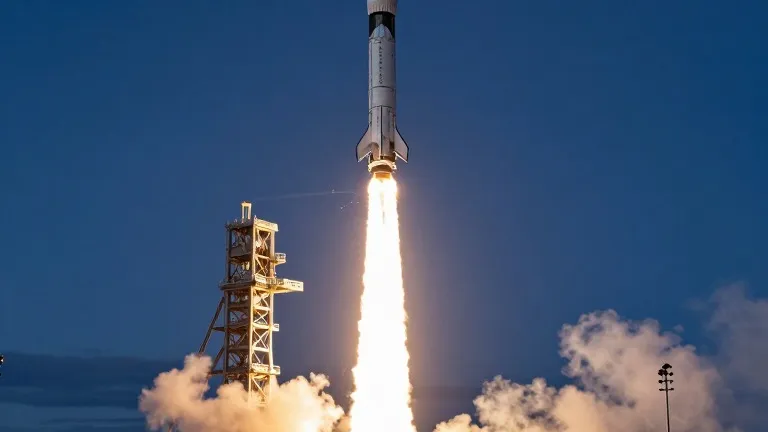
An Electron rocket lifted off from Rocket Lab’s New Zealand facility at 3:11 a.m. EDT on Oct. 23, carrying three new satellites for HawkEye 360. The launch marked the company’s 19th mission of the year and its 98th flight overall. The payload was released into low Earth orbit at an altitude of 323 miles, or 520 kilometers.
HawkEye 360, a Virginia-based firm, uses the satellites to scan the planet for radio frequency emissions. The company stated that these spacecraft operate in clusters of three to collect data for maritime tracking, GNSS jamming detection, and radar monitoring. They also support communications mapping and space defense efforts.
The firm provides this intelligence to the U.S. government and its allies. In a mission summary, the company said its goal is to enable faster and better decision-making. It noted that its proprietary signal processing and AI-powered analytics transform knowledge of the radio frequency spectrum into a strategic advantage.
This launch followed a similar deployment by only two days. Three other HawkEye satellites flew on SpaceX’s Bandwagon-5 rideshare mission. The company’s first satellites entered orbit in 2018, and the recent launches have brought the total fleet size to nearly 50 units.
Rocket Lab named the mission "We're Not Hawking Around" as a reference to the customer. The Electron rocket used for the flight stands 59 feet tall. Sixteen of the company’s 2026 flights have used this two-stage vehicle, while the remaining three utilized HASTE, a suborbital variant designed for hypersonic testing.