College Football Conference Games Reach Lowest Margin Since 1973
Data from Sportradar shows 128 close conference contests through Week 8, marking the highest number in at least half a century.
By Thiago Kovalenko ·
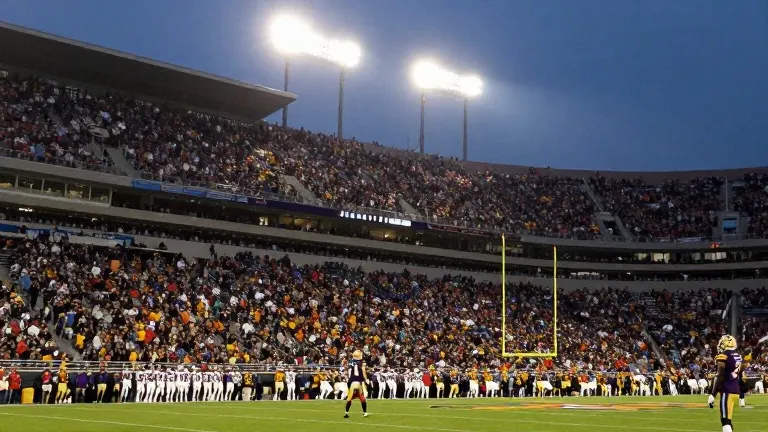
College football conference play has produced its closest results since at least 1973. According to data provided by Sportradar, 128 conference games were decided by eight or fewer points through Week 8 of the 2026 season. This total exceeds the count from the same point in the previous season by 32 games. The average point differential in conference matchups stands at 13.9 points, a figure that represents the lowest recorded level in the dataset's history.
The surge in tight competition continued during the most recent week of play. A total of 30 one-score contests occurred in conference play across the Bowl Subdivision. This single-week total is the highest recorded in at least half a century. Coaches and analysts frequently reference parity in the sport, and these statistical trends support that narrative. The data indicates a shift in competitive balance that extends across multiple conferences.
The Power Four conferences account for the majority of these close outcomes. Sixty-nine one-score conference games have been played in the Power Four so far this season. The Atlantic Coast Conference leads this group with 20 one-score games out of 39 played, representing a 51 percent rate. The Big Ten follows with 19 one-score games out of 38 played, a 50 percent rate. The Southeastern Conference has recorded 17 one-score games out of 39 played, or 44 percent. The Big 12 trails the other Power Four groups with 13 one-score games out of 33 played, a 39 percent rate.
The closeness of these games has influenced betting lines and team strategies. For example, Miami faces North Carolina on Saturday with a prediction of a 38-21 victory. The Tar Heels allowed Syracuse to score in the fourth quarter of their previous game. Ohio State travels to the West Coast for its first game without Julian Sayin, with a projected 24-17 win. Georgia plays Florida after an open week, facing a potential return of quarterback Aaron Philo or a continuation of Tramell Jones.
Other matchups feature teams seeking momentum or rebounding from losses. Indiana is favored to beat its opponent 23-10, despite scoring no more than 20 points in its last three games. Notre Dame aims for a 45-14 victory against Navy, seeking to move past its previous loss to BYU. Utah faces Cincinnati in a matchup where the Bearcats recently defeated Texas Tech, with Utah projected to win 28-19. UCLA plays a Mountain West team, with a pick of 33-7 based on quarterback Ty Dieffenbach's development.
BYU hosts a game against a team that struggled against Kansas State, with the Utes expected to win 34-20. Texas faces a Bulldogs team that lost its starting quarterback, with a projected 45-21 win. Mississippi plays Auburn, with a pick of 35-21, as the Rebels seek to secure playoff hopes. Arizona travels to Texas Tech, a program that has not won in Lubbock since 1935, with a projected 34-24 victory for the Wildcats.
Wake Forest faces Virginia, with the Deacons projected to win 31-13 after four consecutive victories. SMU plays on the road for the first time in six weeks, with a pick of 33-24. Boise State faces Colorado, a matchup described as a contest between two young coaches, with a projected 42-40 win for the Broncos. Northwestern returns to Eugene to face Oregon, with a pick of 30-27. Missouri faces a team where All-America running back Ahmad Hardy has returned to practice, with a projected 31-17 win. Oklahoma State plays Iowa State, with a pick of 41-20. Iowa faces Wisconsin, with a projected 14-13 win, despite being without running back Kamari Moulton.
Several teams receive a bye this week, including Kentucky, Alabama, LSU, Tennessee, and Houston. The predictive model has a season record of 100-39 against the spread and 68-69-2 against the point spread. Last week, the model went 10-7 straight-up and 8-8-1 against the spread.